

10 Onboarding Lessons: From The New York Times to KPMG


TL;DR — the best onboarding programs:
- Connect new hires to a clear mission from day one
- Run for 90 days or longer, not just a single event
- Involve managers and teams, not just HR
- Keep evolving based on real feedback
- Personalize support, from benefits to team dynamics, instead of a one-size-fits-all approach
1. Design your onboarding around the mission
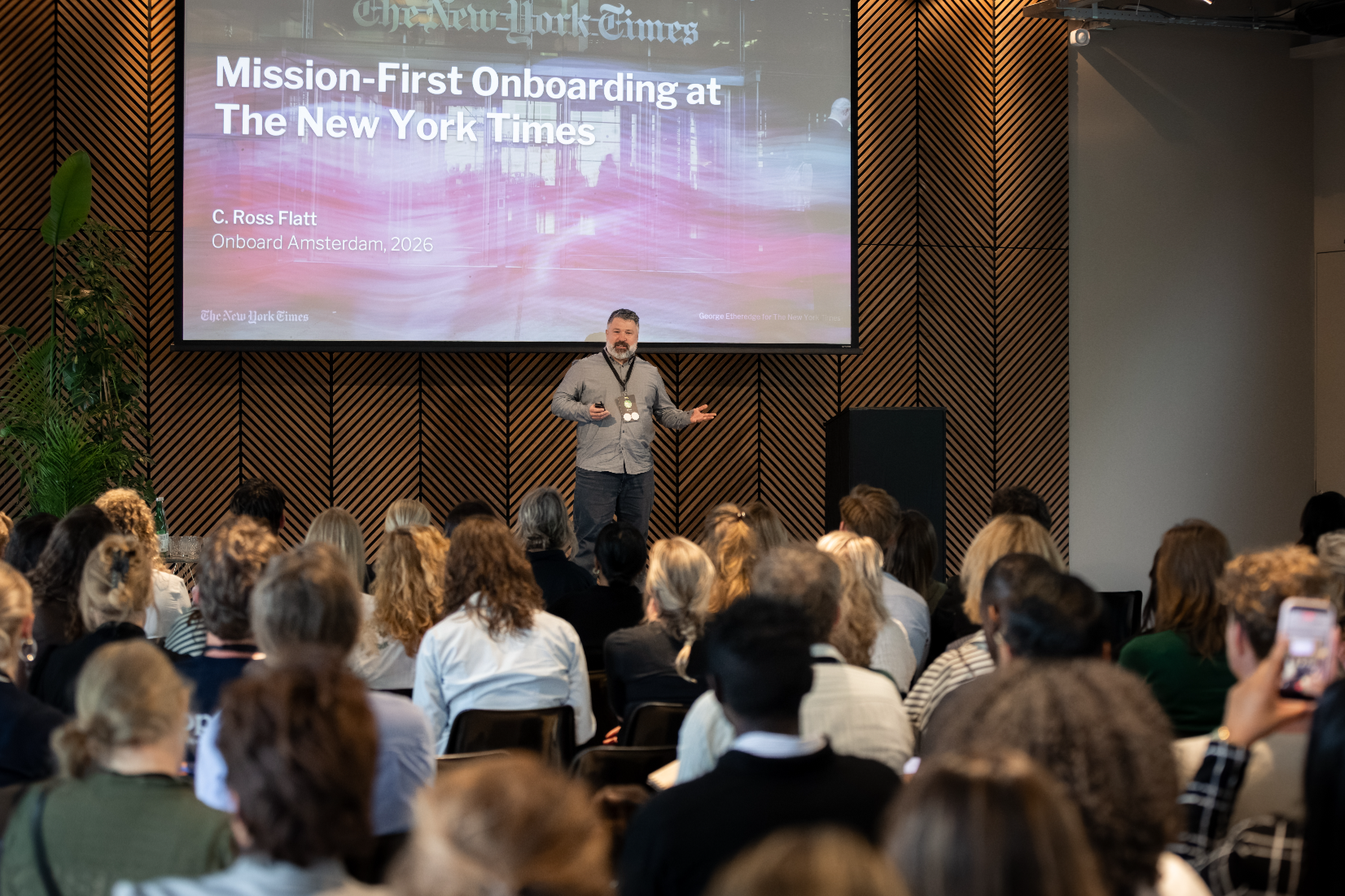
What do you want a new hire to remember after 90 days? At The New York Times, the answer is crystal clear, and they design onboarding around it: "we seek the truth and help people understand the world."
It's not a values module tucked away on day two. It's a mission that shows up everywhere. Ross Flatt (Sr. Manager of Learning & Career Enablement) breaks down how that works in practice: day one centers on mission and values, day two on how the business supports that mission, day three on how journalism brings it to life.
The result? New hires understand how their own work feeds into something bigger, whether they're a journalist, an engineer, or working on the business side. Ross sums it up in one principle: anchor everything in the mission. Make sure it shows up in every session, every conversation, every piece of content.
So ask yourself: what belief do you want new hires to walk away with after 90 days? Start there, and build everything around it.
2. Great onboarding builds a thriving environment, and it pays off
Onboarding isn't about company history, who sits where, or where to park. Yet that's exactly what most onboarding programs still look like. Annemieke van Agthoven, HR Director at Kiwa, flips the script: it's about making people feel seen.
Get that right, and you create an environment where new hires feel at home faster, which makes them more productive faster too. That means actively bringing people into your culture, norms, and values for at least six to eight months.
In practice, that looks like:
- Assign a mentor
- Set goals for the first 30, 60, and 90 days
- Schedule regular check-ins, weekly at first, then monthly, to talk through the unwritten rules and ways of working
Wellbeing doesn't end with onboarding
A thriving environment doesn't stop once onboarding ends. Chief Health Officers and Urban Sports Club pointed out that your brain isn't wired to keep you healthy. Neither is your environment. We weren't built for inactivity, but our workdays are built around it anyway.
The win isn't in big interventions. It's in small changes that stick: breaking up sitting every thirty minutes, motivating yourself and your colleagues to build movement into the daily routine. That focus on wellbeing belongs just as much in the first few months as it does years down the line.
3. Onboarding isn't a single moment, it's a journey
Most onboarding programs last a day or two, then go quiet. Meanwhile, new hires spend the next few months figuring out how things actually work around here. KPMG and the City of The Hague take a different approach, spreading onboarding out in clear phases over time.
KPMG works with milestones: pre-boarding through Appical 30 days before start, a two-day onboarding event in the first week, and a "Your Impact" day at an external location around day 50.
The City of The Hague marks out different moments over time in its Hague Introduction Program (HIP): handy information before you start, an introduction day in the first month, a course on understanding The Hague within the first two months, and an employee café after 100 days. They've mapped the whole thing out like a tram line, a fitting touch for a city where trams are part of everyday life.
The structure looks different everywhere, but the principle holds: onboarding that ends after a week isn't onboarding at all.
4. Onboarding is a shared responsibility
Onboarding is a team sport, but in a lot of organizations, HR is still the only one playing. The New York Times does it differently: make sure new hires never feel like onboarding is "just HR" or "just my manager."
The integration team at The New York Times includes, at minimum, a hiring manager, an onboarding buddy, an HR business partner, and Times Learning. HR's job isn't to do it all. It's to design the shared touchpoints and make it clear who owns what.
A practical starting point from The New York Times: spend 15 minutes with a manager and ask, "Who are the three to five people responsible for this person's successful start?" Put those names in a simple overview and share it with the new hire on day one.
5. Getting managers on board takes data, not just goodwill
Managers say onboarding matters, but in practice, it often falls by the wayside. Calendars fill up, other priorities take over, and HR will handle it anyway. It's one of the most common roadblocks in onboarding, and one of the hardest to fix.
Dutch organization KVK raised this exact issue in their workshop, and a handful of solid ideas surfaced fast. Data-driven thinking turned out to be one of the strongest levers: show managers the actual impact of onboarding. Make them part of the feedback loop with new hires. Hand them ownership by giving visibility into cost per hire, turnover numbers, and absenteeism. Making the value of onboarding measurable turns the conversation with managers into something concrete.
Another idea that landed well: an incentive system where managers who score well on onboarding earn points the whole team can cash in on. That way, their effort gets recognized, and the team becomes part of welcoming new colleagues too.
6. Treat onboarding like a product you keep improving
Onboarding is a program, not a project. Yes! We Connect compares it to caring for a plant: "you're always checking what it needs, water, food, and the occasional repotting." Want to keep developing your program? Start by mapping out what new hires actually need. Those insights become your objective basis for every decision you make.
The New York Times turns this into practice by measuring and asking for feedback at multiple points:
- Post-orientation surveys, right after day one and the intro days, asking how welcome people felt, whether they understand the mission, and whether they can find their way around.
- Lifecycle pulse checks, at day 15, 60, and 180, asking about job satisfaction and whether people have the tools and training they need.
- Focus groups, small sessions with new hires and managers digging deeper into what's working, what's confusing, and where the gaps are in the journey.
- Annual retrospectives, formal reviews with stakeholders covering what changed, what worked, and what's on the roadmap for next year.
That feedback isn't there to report on. It's there to act on.
7. Keep investing in connection, well past day 100
What if onboarding never really ends? That's the question the City of The Hague asked itself after the success of its Hague Introduction Program (HIP), and kept building from there.
HIP taught them three things: connection comes from meeting people, engagement comes from context, and culture comes from shared experiences. Great insights, but they don't only apply to new hires. They apply to every employee.
That's why they developed the Hague Development Program (HOP): a re-introduction day, online deep-dives, lectures, and site visits for people who've been with the organization longer. The idea is simple: you maintain connection and engagement by continuing to invest in shared moments. And that's not a one-time thing, it's an ongoing one.

8. Working well together isn't a given
New hires don't step into a blank slate. They step into a team, with its own dynamics, unspoken expectations, and silos. Fruitful and Zonnehuisgroep Amstelland show just how fragile that foundation often is, and how much impact it has on new colleagues.
They introduced three foundations needed for open, effective, and considerate collaboration: safety (can I be myself?), trust (can I count on you?), and connection (do I feel like part of the team and the outcome?). This is the baseline, and without it, everything else falls flat.
After a program focused on exactly these three elements, employees at Zonnehuisgroep Amstelland reported more contact, faster requests for help, clearer expectations, and fewer silos.
Keep in mind: teamwork is never "done." You keep measuring, spotting issues, and adjusting. Think of a dashboard tracking team dynamics and pulse checks mapping changes over time, so you stay on top of it, even as new people join.
9. Share the right benefit, at the right moment
Nike knows what you like to wear. Spotify knows what you want to hear tonight. We've come to expect hyper-personalized experiences everywhere we go, except at work. So why do employers know so little about what their people actually need?
Ruben van den Boogaard (Alleo) lays out the problem: more than 30% of total compensation goes unnoticed. According to Alleo's presentation at Onboard Amsterdam 2026, employers pour 30% of payroll into benefits like vacation pay, pension contributions, mobility budgets, and insurance, yet most employees have no idea what their package is worth or what's even available to them.
And that makes sense. New hires are hit with thousands of pieces of information a day, and according to Alleo, after day one, 70% of new information is already gone. Without repetition, benefits awareness drops to around 10%.
The fix isn't more budget or more benefits. It's personalization: the right benefit, for the right person, at the right time. Everyone's at a different life stage with different circumstances. That calls for re-boarding: not telling people once and moving on, but bringing them back to what's available whenever their situation changes, not just when they walk in the door.
10. HR, take the wheel on AI
AI in the workplace sparks curiosity and hope, but also real uncertainty about the future. OpenUp found that many organizations are still deep in the experimenting and training phase, underestimating the human side of that shift. That's exactly where HR comes in: prioritizing psychological safety, mental support, activation, and inclusion.
HR and AI expert Margot van Brakel zooms out to the bigger picture. As an HR professional, you can operate on multiple levels: operational, focused on processes, compliance, and efficiency, or strategic, focused on EVP, skill frameworks, and people analytics.
But it only becomes truly strategic once you take control of the human-machine balance. What decisions is AI already making in your organization? Look at the human side too: define a vision for why you exist and what that means for your people. And create the conditions where talent becomes visible and people can genuinely thrive.
Her advice:
- Start with yourself: ask the "why" question, feed yourself input on people, talent, and AI, and approach it with a beginner's mind. If HR were a blank page, what would you put on it?
- Open the conversation: start the dialogue with your team about concerns and possibilities, find allies, and take the lead on roles that are disappearing.
- Look at existing work differently: ask the AI question for every open role. For every process, ask what could be different, and what AI could take over.
So the real question isn't what AI can do. It's why HR exists in the first place, and how you stay human-centered in a world that keeps getting more digital. With all this technology around, what people bring to an organization is what sets it apart. And HR is uniquely positioned to lead the way.
These lessons surfaced at Onboard Amsterdam 2026, Appical's annual event for anyone who believes the first months of a new job genuinely matter. The insights came from The New York Times, KPMG, Yes! We Connect, the City of The Hague, Kiwa, OpenUp, Alleo, KVK, Fruitful, Zonnehuisgroep Amstelland, Chief Health Officers, Urban Sports Club, and Margot van Brakel.
Join 6.956 HR and onboarding specialists!
Have all our latest onboarding news delivered to your inbox. Sign up for our monthly newsletter.
Related posts
Want to know more about onboarding? See our other blogs

Onboarding and the role of the manager
Are you looking for a couple of tips to adopt onboarding organization broadly?

7 Onboarding Tips to Retain Your Employees in 2026
Discover essential onboarding strategies to engage and retain your talent. Learn more about transforming your onboarding program with these 7 tips.

How to create a 30-60-90 day onboarding plan for your new hires
As part of your onboarding program, a 30-60-90 day plan empowers you to lay out a clear course of action for your new hire during the first months.