

What to Expect in HR and Onboarding for 2026


Two themes connect everything. First, social connection and belonging now predict newcomer success more than any other factor. Second, being able to adapt, both as a person and as a company, isn't optional anymore in a world of constant change.
The challenge is that just when human connection matters most, it's getting harder to achieve. Remote work, loneliness, and mental health struggles mean connection won't just happen on its own. If you don't intentionally design for connection, onboarding becomes transactional, and newcomers leave.
Organizations that balance digital efficiency with genuine human connection will win the talent war.
1. Belonging became the strongest predictor of success
Why this matters
How quickly someone feels "I belong here" strongly predicts their success. Research indicates that social acceptance has the most significant impact on outcomes such as turnover and well-being. This makes it a central factor in onboarding (Talya Bauer).
When employees are working remotely or through screens, connections don't just happen. You have to create them on purpose. We'll dig into this more in the next sections. For now, here are some ways to help new hires feel like they belong:
What to do?
- Start before day one: Give new hires a buddy who reaches out before they start. Just to say hi, introduce themselves, and answer casual questions.
- Build moments to connect in the onboarding timeline: think coffee chats with people in related roles, shadowing sessions, and informal Q&As where new hires can ask anything.
- Check how people are feeling: Send quick surveys at different points during onboarding. Ask things like: "Do you know who to go to for help?" and "Are you clear on what's expected of you?"
2. Onboarding is a business necessity
Why this matters
Bad onboarding costs real money: people leave, productivity drops, and you waste what you spent hiring them. At the same time, the job market is still competitive, and hiring takes longer than ever. The average time to fill a role globally is now 44 days (some industries take over 60). And replacing someone? That can cost you 6-9 months of their salary. (Centric HR).
The numbers reveal the stakes. 70 percent of new hires decide if a new job is the right fit for them within the first month, with 29 percent knowing within the first week (BambooHR).
This isn't inevitable: organizations with strong onboarding processes can improve retention by 82% (Brandon Hall Group). The gap between good and poor onboarding shows up directly in business results.
What to do
- Shift how you think about onboarding: It's not just a welcome event. It's what keeps people around and performing well.
- Track the metrics that reveal impact: How fast people get up to speed, whether they stick around past 90 days, and how they feel about their job and your company.
- Make the business case: Show what bad onboarding actually costs: rehiring expenses, lost productivity while roles sit empty, and the chaos of constant turnover on your team.
3. Preboarding is your first line of defense
Why this matters
As we saw earlier, the majority of new hires decide if a job is right for them within the first month (BambooHR). Still, most companies wait until day one to start onboarding. By then, the battle for retention has already begun.
The time between offer acceptance and day one is critical. Candidates are still weighing other options, and companies without structured preboarding lose people before they even start, or within the first few days. Yet 64% of employees don't get any preboarding at all (Talentech/Vlerick). That's a missed opportunity to build confidence and connection when it matters most.
What to do
- Keep the conversation going: Send a welcome message within 48 hours of acceptance.
- Share key information upfront through your onboarding platform or welcome portal: think company culture, team structure, first-week schedule, and role expectations
- Answer practical questions to calm first-day nerves: Where do I park? How does the access card work? What's the dress code? Where do I go first?
- Introduce a buddy or mentor so new hires have a go-to person before they start
- Host a virtual team meet-and-greet before day one to put faces to names and ease social anxiety
4. Remote Work and Technology: Balance Efficiency with Connection
Why this matters
Remote work isn't new anymore, but it's still relevant. Nearly 23% of U.S. employees work exclusively remote and 52% work hybrid (Gallup). Even if your team works in an office, onboarding probably includes digital parts, like online training, digital documents, and automated tasks.
Technology is great for sharing information quickly and consistently. Remote work makes some things easier, too, like searching for info, seeing everyone's name on video calls, and checking if someone's available.
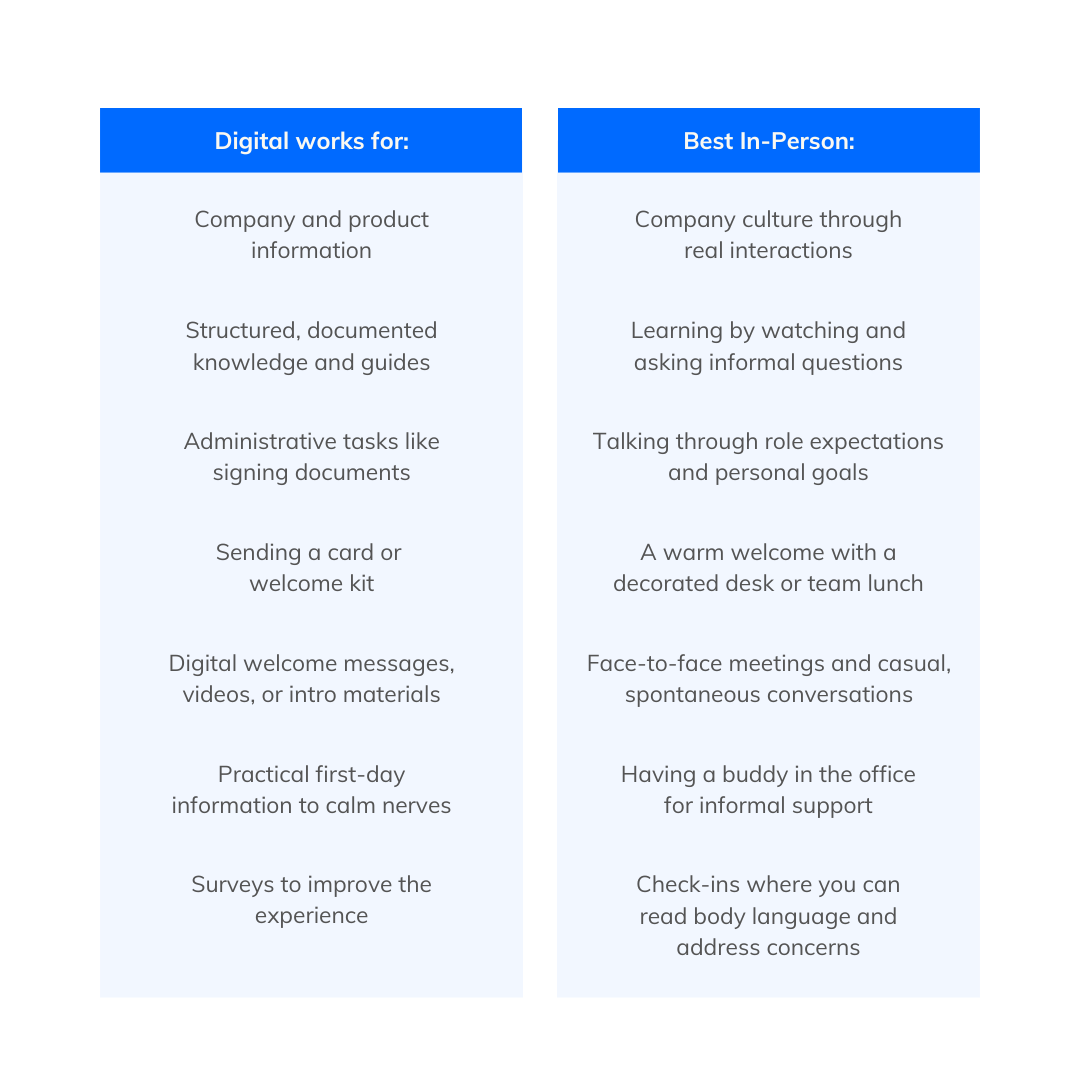
But here's what it can't do well: help people feel like they belong, let them learn by watching others, or pick up on unwritten rules. And as we talked about earlier, feeling connected is what makes people stay and succeed.
The trick is knowing what works where. Some things work great online. Others need to happen face-to-face:
What to do
- Mix digital efficiency with human touchpoints: buddies, regular check-ins, and social moments.
- Schedule connection moments for remote workers: Don't wait for it to happen naturally. It won't.
- Give people multiple ways to ask questions: Formal meetings, instant messaging, and open office hours.
- Make info easy to find: Let people look things up on their own.
- Pick tech that creates real connection: Not just tech that speeds things up.
5. AI embeds into daily work
Why this matters
Are you also anxious about how AI will change your job, even if it's not there yet? Feeling the pressure to "do something with AI" but not sure what that actually means for onboarding?
You're not alone. Almost half of HR teams aren't (or are only somewhat) involved in shaping their company's AI strategy, and around 70% say they lack the skills to work with it effectively (Brandon Hall Group).
But here's the risk: when HR sits on the sidelines, you fall behind in recruiting and retention, get caught off guard by automation, and risk AI getting built without thinking about people or ethics. Meanwhile, employees expect tools that feel modern and make their jobs easier.
The experimentation phase taught us a lot. Now it's about getting practical: identifying specific use cases where AI solves real problems in your workflow
And there’s a lot where AI can actually help:
- Data analysis: Track how onboarding is going and spot what needs fixing by pulling together feedback surveys, quiz scores, and performance data.
- Handling admin tasks: Collect documents, pre-fill forms, schedule meetings, send reminders, and track completion.
- Answering questions 24/7: Agents handle common questions about tools, benefits, and processes anytime.
- Personalized journeys: Send nudges and tips that are tailored for the individual.
- Smarter training recommendations: AI can suggest and curate relevant content based on someone's role, which reduces onboarding time, improves knowledge retention, and boosts satisfaction (Pichaimani and Ratnala).
What to do
Get involved in your company's AI strategy: Don't wait to be invited! Make sure AI gets used responsibly, strategically, and in ways that support people.
And remember: keep the human parts human. Use AI for repetitive tasks and data, but protect face-to-face connection and personal support.
6. Mental Wellbeing shapes onboarding design
Why this matters
Starting a new job is stressful. The first weeks are filled with uncertainty: Am I doing this right? Do I belong here? Who can I ask for help?
Onboarding plays a major role in how people experience that stress. Poor onboarding amplifies anxiety: lack of clarity, no support system, information overload. This can push people toward early exits.
Good onboarding does the opposite. Structured onboarding and training programs can effectively decrease stress, anxiety, and burnout among new hires (Frögéli et al.). Through connections with coworkers and leaders, onboarding builds relationships that buffer against stress and improve wellbeing.
Onboarding is also your first chance to show people that their wellbeing matters. And this matters to job seekers. 81% of employees consider how companies treat mental health when deciding on a new role (American Psychological Association). When you build wellbeing into onboarding from day one, you signal it's not a separate program, it's how you work.
What to do
- Cut down uncertainty: Give clear role expectations, priorities, and examples of what "good" looks like. Unclear goals are one of the biggest workplace stressors (Comparably)
- Assign mentors or buddies: Pair new hires with someone who offers both task guidance and emotional support.
- Get leaders involved: Direct support from leaders reduces stress and helps new hires feel valued (Adrian et al.).
- Create connection opportunities: Build in activities that help new hires bond with coworkers. Research shows strong coworker relationships improve mental health (Cooper-Thomas et al.).
- Make mental health resources visible from day one. Make them easy to find and normalize using them.
7. Transparency beyond pay: Show the real job
Why this matters
It’s just a matter of time before salary transparency is mandatory in the EU. But transparency is about more than pay. It's about being honest about the realities, challenges, and culture from the start. The cost of overselling is real: 55% of employees have quit a job because it didn't match what they were told during hiring (ThriveMap)
This includes hybrid work clarity. Candidates aren't pushing for remote-only; they're pushing for clear expectations. When and why do in-office days matter? What does flexibility mean?
What to do
- Name the salary: Salary is the most important factor for job seekers. Don't say "competitive" or "market rate". Research shows that listing salary in job posts attracts 51% more applicants (Nationale Vacaturebank).
- Show what the job actually looks like: Add day-in-the-life details and honest challenges to job posts.
- Be specific about flexibility: What does "flexible working hours" really mean? Can people work from home? Which days require office presence? Can they leave early if their kid is sick?
- Share examples of growth opportunities: Don't just say there are growth possibilities; give concrete examples of what the next step could look like in the role.
8. System Integrations Became a Must-Have
Why this matters
Your onboarding platform shouldn't work in isolation. It needs to be part of a connected HR operating system. When your onboarding tool integrates seamlessly with your HRIS, ATS, payroll, and communication platforms, you reduce friction rather than create it.
Manual workarounds waste time, create compliance risks, and frustrate new hires with missing access and duplicate requests. New hires shouldn't have to hunt for information across multiple platforms. And HR shouldn't spend hours manually entering the same data into different systems.
When systems connect properly, things work more smoothly:
- One workspace: HR, IT, facilities, and managers collaborate without jumping between tools.
- Fewer errors, stronger compliance: Data flows automatically with built-in audit trails.
- Better experience: For new hires, it feels like one smooth process.
What to do
- Map your manual work: Identify where you're copying data between systems by hand. That's where integrations matter most.
- Ask about integrations upfront: When evaluating new vendors, make integration capabilities a priority question. Which systems do they connect with? Public documentation, customer use cases and integration marketplaces are also important proof points to look for.
- Test the flow: Before rolling out, walk through a mock onboarding to ensure data flows correctly and nothing falls through the cracks.
9. IT Teams Get a Stronger Voice in HR Technology
Why this matters
Cybersecurity risks are rising, which means IT teams and security leaders now have a bigger say in HR technology choices. Data breaches, geopolitical tensions, and tighter regulations mean security shapes decisions from the start. HR can no longer select (onboarding) tools without IT input on data flows, encryption standards, and vendor risk.
What to do
- Bring IT in early: Get your Chief Information Security Officer (CISO) involved when evaluating onboarding platforms.
- Ask the right security questions: What certifications does the vendor have? How do they handle and protect data? What security controls do they offer?
- Treat IT as a partner: They're not a hurdle to clear; they're helping you avoid risks that could hurt the entire organization.
10. Age Diversity Requires Different Onboarding Approaches
Why this matters
The workforce is aging and becoming more age-diverse (Eurostat, 2023), yet most onboarding follows a standard template that doesn't account for different career stages.
That one-size-fits-all approach ignores the reality: a multigenerational workforce brings diverse prior experiences, expectations, and motivations. Someone joining at 45 has different needs than someone at 22, but onboarding rarely reflects that.
Research shows different age groups are motivated differently: younger workers tend to value receiving knowledge and learning from others, while older workers often prefer sharing their expertise (Burmeister et al.). When onboarding creates space for both, cross-generational learning flows in both directions.
What to do
- Design for different life stages: Tailor onboarding to address where people are in their careers, not just their job title.
- Train managers to drop age assumptions: Ensure supervisors invest equally in all newcomers, regardless of age.
- Enable cross-generational learning: Create opportunities for people to both learn and contribute. Make age diversity a strength.
[.callout-small]Want to know how to onboard Gen Z specifically? Read our guide on onboarding Gen Z[.callout-small]
Join 6.956 HR and onboarding specialists!
Have all our latest onboarding news delivered to your inbox. Sign up for our monthly newsletter.
Related posts
Want to know more about onboarding? See our other blogs

7 Onboarding Tips to Retain Your Employees in 2026
Discover essential onboarding strategies to engage and retain your talent. Learn more about transforming your onboarding program with these 7 tips.

What is the ROI of a good onboarding program?
Stop the hidden financial drain. Learn the true cost of bad onboarding and discover your Onboarding ROI to see your potential savings.

How to onboard and retain Gen Z? Expert Laura Bas shares tips
Gen Z is taking over the workforce. Discover how to attract, onboard & retain Generation Z talent—with actionable tips from expert Laura Bas.